
Welcome to Ottawa County, Kansas
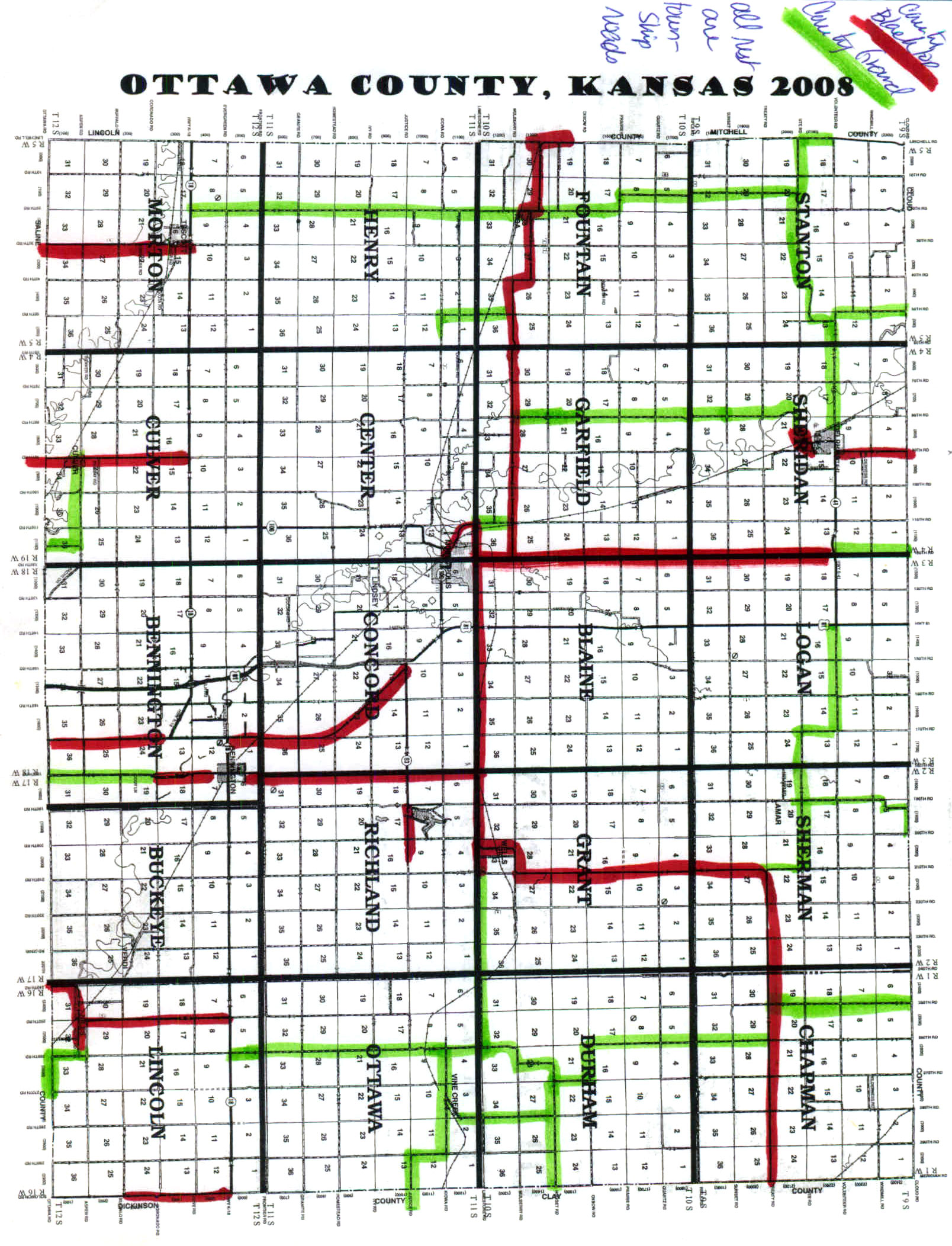
Right-of-Way Haying & Baling Permits
Individuals, businesses, or organizations wishing to mow County road rights-of-way for the purpose of haying or baling must obtain a Right-of-Way Haying/Baling Permit from the Ottawa County Road & Bridge Department before any mowing begins.
Permit Information
- Permit applications are accepted beginning January 1 for the current year's haying season.
- Adjacent landowners receive first priority and may apply for permits through March 31.
- After March 31, any remaining rights-of-way will be assigned on a first-come, first-served basis.
- Applications must be submitted by May 15.
- There is no fee to obtain a haying/baling permit.
- Either the permit holder or Ottawa County may cancel the permit by providing three (3) days' written notice.
Permit applications are available from the Ottawa County Road & Bridge Department and may also be downloaded from the Ottawa County website.
Important Notice
Haying or baling any County right-of-way without a valid permit is prohibited.
A person found haying or baling a County right-of-way without the required permit is subject to a $200 fine.
For questions or to obtain a permit application, please contact the Ottawa County Road & Bridge Department.
After many months of study and public meetings, the Ottawa County, Kansas, Comprehensive Plan was adopted by the Ottawa County Planning Board and approved by the Board of County Commissioners in February 2005. The County Commissioners have designated Truette McQueen as County Zoning Administrator. His office is located on the first floor of the Courthouse in Suite 106 and his telephone number is (785) 392‑3037.
The Zoning Regulations comprise five zoning districts. They seek to achieve several objectives:
- To encourage urban type development in and around cities where infrastructure and services are more available.
- To generally discourage nonfarm development in rural areas in order to preserve agricultural land except for (a) low density residential use, and (b) such nonfarm uses as may be expected to locate in a rural area.
- To provide lot size incentives which would encourage the grouping of nonfarm dwellings into platted subdivisions.
- To preserve existing small unincorporated urban areas as "villages" by establishing minimal regulatory standards.
- To allow a limited amount of commercial and industrial zoning at selected locations upon application for rezoning.
- To limit the placement of older type mobile homes, i.e., pre‑1976 construction, in favor of "residential‑design manufactured homes" and "manufactured homes" which meet the National Manufactured Home Construction and Safety Standards Act of 1976 otherwise known as the HUD Code.
- To plan for the anticipated County's participation in the National Flood Insurance Program by the adoption of floodplain regulations and rate maps possibly in early 2006.
Certain structures and uses are exempt from the proposed Zoning Regulations such as:
(1) Utility distribution systems except major substations;
(2) Railroad tracks and their related equipment and activity
(3) Structures and land owned and operated by the federal government;
(4) Drilling and operating oil and gas wells;
(5) Family burial plots; and
(6) The use of land for agricultural purposes including related accessory structures thereon which are not located in a designated floodplain.
The state statutory provisions for exempting agricultural use of land and related structures would also extend to animal feedlots in the unincorporated area of the county. A farmhouse and a modular dwelling on a foundation are also exempt as well as single and multi‑wide manufactured homes either skirted or placed on a foundation. The definition of agriculture in the regulations recognizes that Kansas is a "right‑to‑farm" state under K.S.A. 2‑3201, et seq. which limits nuisance suits and injunctions. While an agricultural compliance certificate may be requested to determine the agricultural exemption status, no fee is required for the certificate nor a zoning permit for exempted agricultural structures which are not in a designated floodplain.
All lawfully existing structures and uses which would not otherwise be permitted outright by the regulations would be "grandfathered‑in". They can continue to do what they have done in the past and expand under certain circumstances. Zoning is not generally applied retroactively; however, provision is allowed to remove the storage of junk and wrecked or dismantled vehicles after five years which are not in an industrial district. As a voluntary procedure to reassure owners that their property will be recognized in the future as having been grandfathered‑in, i.e., determined to be "legal, nonconforming", registration forms will be available at the Zoning Administrator's office for recording legal nonconformities and exemptions as a vested right.
The adoption of such regulations would not: (a) raise any taxes; (b) increase any appraisals; (c) cause land to be annexed to a city; or (d) prevent the sale, transfer or inheritance of property. Any division of land, however, would still have to meet the provisions of the proposed Zoning and Subdivision Regulations. Obtaining a zoning permit would be required for a proposed structure or use except for the six exemptions listed previously. A zoning permit is not a "building" permit in that it does not control how or with what materials a structure is constructed. It does control the use of structures and land and their bulk dimensions on a zoned lot by setback dimensions from roadways and adjacent landowners.
A brief description of each zoning district classification is summarized below:
A. A‑1 Agricultural ‑- This district is established to preserve productive farm and ranch land by allowing only certain low-density dwellings and nonfarm uses. Nonfarm residential uses would require at least a minimum lot size of 20 acres except for various exceptions. Other uses would need a minimum of 40,000 square feet. Certain exceptions would apply for (1) dividing off an existing farm dwelling from the farmland; (2) using an historical dwelling site for a new residence; and (3) an existing lot or tract of land used as a residential building site even if it does not meet the minimum lot size requirements; provided, that it was owned separately and individually from adjoining land at the time the regulations become effective. It has been determined that there are dozens of such lots in the rural area which meet that criteria. In any case, all three exceptions will need to meet the minimum lot size of three acres of the County Sanitary Code for Environmental Protection plus any additional land that may be needed to meet distance requirements for locating sewage disposal facilities.
In addition to the three permitted use categories, there are 18 special uses listed for which application can be made to the Planning Board with final approval by the County Commissioners. In addition to churches and golf courses as permitted uses, the residential nonfarm uses are: Single‑family and earth‑sheltered dwellings, modulars, residential‑design manufactured homes and single or multi‑wide manufactured homes on enclosed, perimeter permanent‑type foundations. Special uses range from airports to quarries and dog kennels to communication towers. They are classified as "special" because they are not automatically appropriate everywhere in the district such as an application for a campground, salvage yard, sanitary landfill or commercial wind energy project. Since it is not possible to foresee all the potential land uses that might want to locate in a rural area, there is a miscellaneous classification that would allow "Other Uses" as special uses to apply and be considered at a public hearing to determine their compatibility to the other uses in the A‑1 zone.
B. V‑1 Village ‑- This district is established to encourage the continued existence of small unincorporated "villages" by placing very minimal restrictions on their development. Single‑family dwellings, modulars and all types of manufactured and mobile homes on land owned by the homeowner may be permitted. In addition, business and industrial uses comparable to the permitted uses listed in the B‑1 General Business and I‑1 Industrial districts would be allowed. The provision for "Other uses" as special uses is also included. The major restriction important to the long‑range welfare of the village is to meet the County Sanitary Code for Environmental Protection.
C. SR‑1 Single‑Family Suburban Residential ‑- This district is established to provide for a minimum of three‑acre lots for rural housing that would also meet the County Sanitary Code for Environmental Protection. Such lots could accommodate single‑ family and earth‑sheltered dwellings, modulars, residential‑design manufactured homes, multiple‑wide manufactured homes on enclosed, perimeter permanent‑type foundations and group homes. They could be laid out on existing County or township roads or grouped into a subdivision. Whereas platting is not required of the district, it is encouraged and will be needed for subdivisions with interior street systems.
D. C‑1 General Commercial ‑- This district is established for a selected group of retail and service businesses. Such uses should desirably be located on major roads, particularly at intersections and/or adjacent to cities. It is not intended to "strip out" roadways or unduly compete with commercial urban centers in cities. There are 15 permitted uses proposed and six special uses including the "Other uses" category. All business, servicing, storage and display of goods are required to be enclosed or screened from public view unless approved as part of a special or conditional use except for the sale of gasoline and the operation of automobile service stations.
E.I‑1 Industrial ‑- This district is established to provide for a broad list of industrial uses to be located at selected locations. Future locations for the I‑1 zone would depend upon applications and subsequent approvals. Because of limited public and private facilities and services in the unincorporated area, the concept is to encourage "light" industrial types which would create less environmental problems yet recognize traditional enterprises that normally locate in a rural area such as greenhouses, agricultural and oil related businesses and livestock sales. Related outdoor operations, storage and display would be permitted. Eleven uses would be specifically prohibited due to their extensive environmental impact, while six special uses including the "Other uses" category are proposed.
The proposed Official Zoning Map delineates district boundaries for the A‑1 Agricultural, V‑1 Village and SR‑1 Single‑Family Suburban Residential districts. New uses in the B‑1 General Business and I‑1 Industrial districts would need to apply for rezoning to establish such zones.
Customary home occupations are permitted on residential lots with a listing of 13 that are prohibited such as vehicle repair and sales businesses and the sale of firearms and ammunition. Some use limitations apply to maintain the appearance of a structure as a residence. By application for a conditional use to the Board of Zoning Appeals, more extensive home occupations with less restrictions may be approved in an agricultural district. Zoning permits are required only for home occupations that display a sign or use an accessory structure although the basic restriction still apply.
A wide variety of uses accessory to a principle use is recognized both permanent and temporary. These include off‑street parking, signs, detached garages, storage buildings, private wind energy conversion systems and garage or yard sales. Detached garages, carports and storage buildings are limited in size in residential districts; however, conditional use applications can be made to the Board of Zoning Appeals for oversized structures.
Because of their relocatable ability, manufactured and mobile homes are permitted to be used in a flexible manner. Under certain conditions, they can be used to (a) replace older homes that have been grandfathered‑in; (b) provide housing for a watchman or custodian; (c) locate a dwelling for additional assistance on a farm or ranch; (d) temporarily provide housing during a disaster; (3) provide temporary housing while constructing a site‑built house; and (f) locate on the same zoning lot as a principle residence if an unusual hardship is shown. No such homes can be used for storage purposes only.
Applications may be made to change zoning from one district to another or request a special use. The procedure is governed by state statutes and involves proper notification of affected parties and a fair and impartial public hearing before the Planning Board. Notification is given in the official county newspaper at least 20 days before the hearing. Individual notices are mailed to owners of real property within 1,000 feet of the proposed rezoning area and 200 feet inside a city if the 1,000 feet extended into the city limits. As a quasi‑judicial process to avoid being arbitrary, capricious or unreasonable, the Board makes a recommendation to the County Commissioners on their findings of 17 factors. Within 14 days after a hearing, protest petitions may be received from the notification area protesting the change in zoning or proposed special use. If 20% of the area notified protests the proposed zoning change not counting public rights of way, the effectuating resolution of the County Commissioners can not be passed except by a 3/4 vote which in Ottawa County would necessitate a unanimous vote. Anyone aggrieved by a decision of the County can appeal within 30 days to District Court.
The Planning Board also serves as the Board of Zoning Appeals. The latter hears and decides appeals from determinations of the Zoning Administrator, variances and conditional uses as exceptions. Variances are hardships to individual property owners which may involve some numerical problem such as a building setback line, the height of a sign of the number of required parking spaces. Conditional uses are much like special uses, but usually smaller in size and of less intensity of activity. They must be specifically listed in the regulations to be considered by the Board. Notification is given in the same manner as rezoning as described above, but no formal protest petitions are permitted. The Board makes a final decision appealable only to District Court within 30 days.
Zoning has as its objectives the grouping of compatible land uses, protecting property values, promoting public health and safety, preserving good agricultural land, and guiding urban growth to those areas where it can best be provided with the necessary public and private services. Zoning is like a "community insurance policy" to protect property from the intrusion of undesirable uses while promoting its best use consistent with private property rights and community concerns.
OTTAWA COUNTY BOARD OF COMMISSIONERS
- Carla Grund
- Scott Mortimer
- Duane Morris
OTTAWA COUNTY PLANNING BOARD
- Martha A. Tasker, Chairman
- Phil Ballou, Vice Chairman
- Gary C. Keating, Secretary/Treasurer
- Arlen Bacon
- Mark Walker
- Joshua Hulse
- Chris Lawson
- Jeff McHenry
- Robert Jilka
- Truette McQueen, Zoning Administrator
- Kim Winsett / Megan Grimes, Recording Secretary
Summary prepared by C. Bickley Foster, J.D./AICP of Foster & Associates, Planning Consultants, Wichita, Kansas ‑- August 2005.
SECTION I
A. Road Surfacing Policy
1. Grading and Rock Surface: The resident making the request for grading and rocking on an undeveloped open road will be responsible for payment of all expenses necessary to bring the undeveloped road up to county standards. After the Ottawa County Road and Bridge Department has graded the road to specification, the resident will then be responsible for township rock as outlined in Item #1. These requests will be handled on a case by case basis, with an estimate of total expense determined after careful review of the request.
B. Any resident requesting a culvert will be responsible for the expense of the culvert and the Ottawa County Road and Bridge Department will deliver upon request and at the County's convenience.
C. Minimum Maintenance Roads and Controlled Access Facility
(K.S.A. 68-5, 102, K.S.A. 68-1901, K.S.A. 19-101)
Upon request from landowner, the Board of County Commissioners will draft a resolution to declare certain roads as minimum maintenance with controlled access. After each particular road has been approved by the resolution process as a controlled access, the following will occur;
Ottawa County Road and Bridge Department will affix a gate across the road, a gate ( which has been approved by Ottawa County), with a lock. The landowners or parties requesting the above will be responsible to pay for the original gate a minimum of $200. At the time, the County will install the gate and be responsible for maintenance on the gate. Keys for the lock will be distributed to the landowners, Sheriff Department, Fire Department, Motor Grader Operator, and the Road and Bridge Department.
SECTION II
A. Sign Policy
1. Requests for signs will be decided on a case by case basis.
2. The entity or individual requesting the signs will pay for the signs and posts.
3. The county will be responsible to set the signs, at the county's convenience.
4. Labor on setting the signs will be negotiable.
Revised this 10th day of April, 2000.
THE OTTAWA COUNTY BOARD OF COMMISSIONERS
Kathy M Luthi, Chairperson
Lon Dean Crosson, Member
Ray McGavran, MemberATTEST
Mary Arganbright, Ottawa County Clerk
CMS - Health Care Financing Admin.
www.cms.gov
Medicare
www.medicare.gov
National Medicare Education Program
www.nmep.org
Social Security
www.ssa.gov
United States Government Information
http://thomas.loc.gov
Government Printing Office
www.gpo.gov
Kansas Counties
http://skyways.lib.ks.us/counties
Kansas Department On Aging
www.k4s.org/kdoa
Kansas Home Care Association
www.kshomecare.org
Last Acts
www.lastacts.com
Kansas Elder Law Network
www.keln.org
Census Bureau
www.census.gov
Gateway to U.S.
www.firstgov.gov
Kansas Senior Centers Association
www.k4s.org/seniorcenters
Subcategories
Ottawa County Courthouse
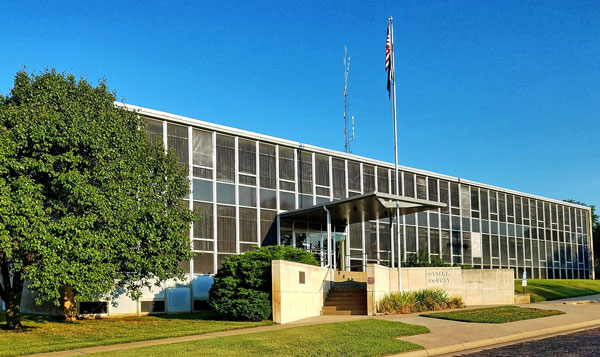
307 N. Concord
Minneapolis, Kansas 67467
Monday - Friday: 8:00 am to 5:00 pm
Closed Noon to 1:00pm for lunch
The Appraiser, Clerk, & Treasurer Offices will remain open during the lunch hour.
Closed Holidays